Understanding News Events in Forex Trading
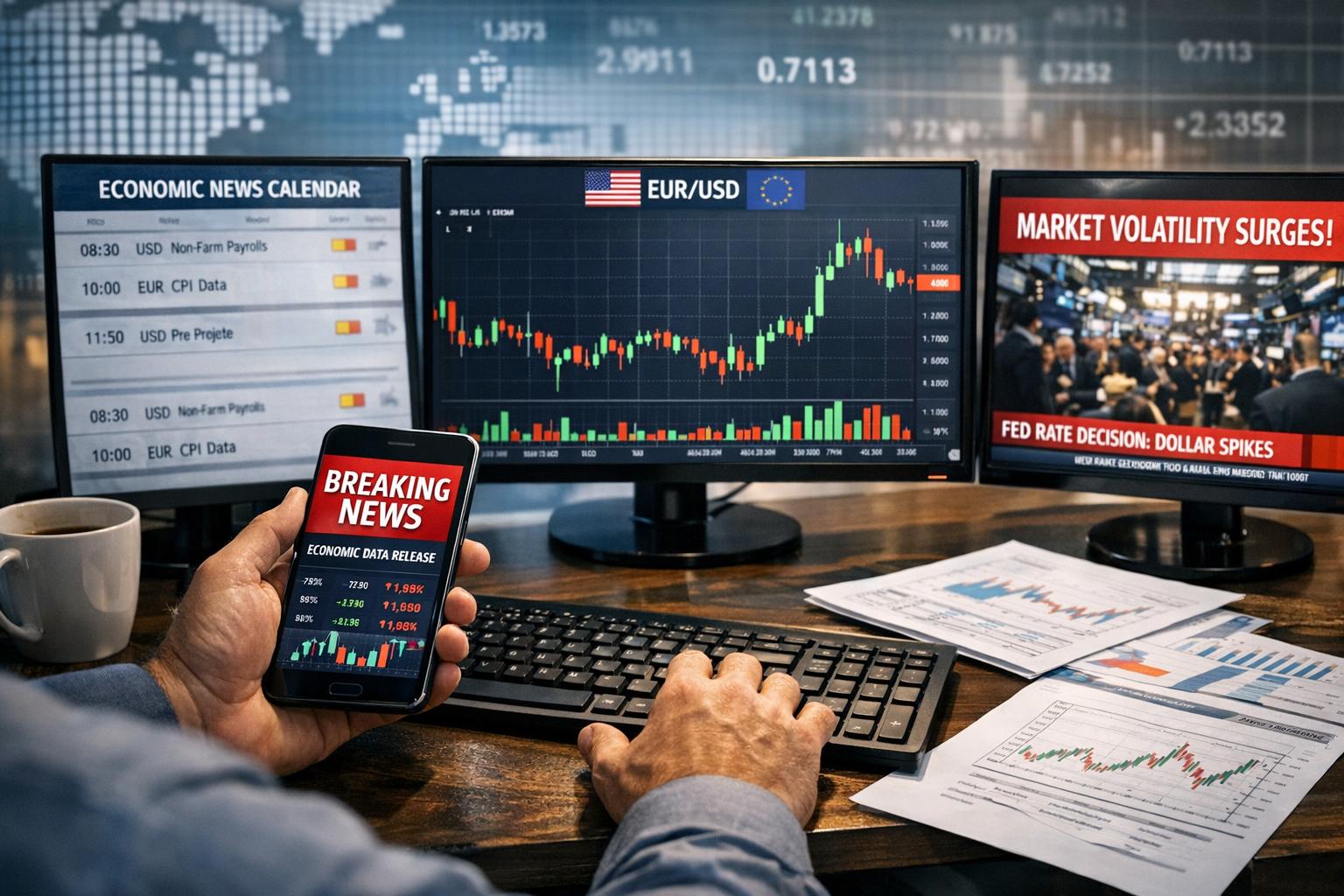
Forex trading on news events isn’t some mystical “future sight” trick. It’s closer to how markets actually work in real time: big releases change expectations, expectations change positions, and positions change price. In the foreign exchange market, traders react to economic updates, central bank signals, and geopolitical headlines that can move currency pairs within minutes.
If you’ve traded forex for any length of time, you’ve probably seen it: the chart looks calm, then a release hits, and suddenly candles appear that look like they were drawn with a marker. The difference between traders who profit from those moments and traders who just donate money to spread costs is usually preparation and process. That’s what this guide focuses on—how to understand the news events that matter, what strategies are commonly used, and how to manage the risks when volatility arrives like it has somewhere to be.
Why News Moves Forex So Fast
Currency markets are forward-looking. Interest rates, inflation expectations, growth forecasts, and risk sentiment all shape what traders believe about the relative value of currencies. When new information contradicts (or confirms) those beliefs, pricing adjusts quickly.
There are a few reasons forex reacts fast to news:
1) Expectations matter more than the raw numbers. It’s common to see a “good” number still cause a currency to fall (because it was less good than expected).
2) Leverage amplifies moves. Many traders use margin, so a fast repricing can trigger stop-losses and margin calls across multiple accounts.
3) Liquidity shifts around major releases. Spreads can widen briefly, slippage becomes more likely, and execution quality matters.
So yes, the news itself matters. But how traders interpret it—relative to forecasts and prior communication—matters just as much.
Types of News Events Affecting Forex
Most forex “news trading” revolves around two big categories: economic data releases and geopolitical events. A third category—central bank communication—often overlaps with economic releases but deserves its own mention because speeches, minutes, and guidance can move markets even when no hard data prints.
Economic Data Releases
These are the scheduled releases coming from ministries, statistical agencies, and central banks. They include employment reports, inflation prints, GDP, trade balance data, retail sales, manufacturing surveys, and more.
Economic releases can be divided into “high-impact” and “medium-impact” groups, depending on how often traders and algorithms react. High-impact releases tend to have clear links to interest rates and growth expectations, which directly influence currency valuation.
Common examples include:
– Non-Farm Payrolls (NFP) for the US labor market
– Inflation reports such as CPI (consumer price index) or PCE (personal consumption expenditures)
– Central bank rate decisions and related statements
– GDP reports and growth forecasts
– Employment and wage data beyond NFP, such as average earnings
When the actual result beats expectations, the currency often benefits because it suggests stronger growth or hotter inflation, which can lead to expectations of higher interest rates or fewer cuts. When the result disappoints, the opposite may occur.
One detail that’s easy to miss: “better than expected” can still be negative for a currency if the prior market positioning assumed an even better outcome.
Non-Farm Payrolls (NFP) as a Case Study
The Non-Farm Payrolls (NFP) report is one of the most influential economic indicators in forex. Released monthly in the US, it measures the number of employed people excluding agriculture (hence “non-farm”). Traders pay attention to:
– The headline payrolls figure (jobs created)
– Unemployment rate (labor market slack)
– Average hourly earnings (wage pressure, inflation link)
– Prior month revisions (sometimes the real story is what changes from earlier data)
A stronger-than-expected NFP often increases confidence in the US economy. That can strengthen the US dollar if traders also expect the Federal Reserve to keep policy tighter for longer. But if wage growth is weak even while payrolls are strong, the reaction might be muted or short-lived. Forex traders, like cats, react more to what moves their assumptions than to what “sounds” bullish.
Inflation Reports and Interest Rate Expectations
Inflation is a direct driver of central bank policy. If prices rise faster than expected, central banks may hesitate to cut rates or may even signal a need for further tightening. That interest-rate expectation typically strengthens the currency.
Inflation reports influence forex through several channels:
– Short-term policy reaction: “Should the central bank act now?”
– Longer-term expectation: “What will the future rate path look like?”
– Risk sentiment: persistent inflation can raise uncertainty about growth and market stability
In other words, inflation data doesn’t just tell you prices today. It tells traders what might happen to rates tomorrow, and rates are the heartbeat of currency valuation.
Geopolitical Events
Geopolitical events include elections, political instability, legislative gridlock, sanctions, conflicts, and major diplomatic developments. These events can influence forex through:
– Risk sentiment: how comfortable investors feel holding riskier assets
– Safe-haven flows: movement to currencies perceived as stable
– Trade routes and energy prices: which can affect inflation and growth
– Sanctions and capital controls: which can directly impact economies and cross-border flows
Elections are a common example. Before election outcomes, markets may hedge their positions as uncertainty rises. After the result, the currency might move sharply if investors believe policy direction will shift fiscal spending, regulation, or alignment with trade partners.
International conflict can also drive safe-haven demand. Traders often move funds toward perceived safety—commonly currencies like the US dollar or Swiss franc—depending on the specific context and broader market conditions.
Central Bank Communication
Even without a scheduled economic release, central bank communication can move forex. Statements, minutes, speeches, and the wording of policy decisions can change interest rate expectations.
For example, a rate decision may be “as expected,” but the language might shift from neutral to hawkish (more likely to keep rates higher). That change can still create a tradable move.
This is where many traders get burned—because the number printed wasn’t surprising, but the guidance was. In forex, guidance is basically the market’s favorite kind of “what if.”
Strategies for Trading News Events
Trading on news events is mostly about aligning your trade plan with what news typically does to price. You don’t need a crystal ball. You need a framework: which releases matter, what “success” looks like, and how you control risk when the market does what it does best—surprises.
There are two broad styles: short-term strategies that aim to capture immediate volatility, and long-term strategies that aim to position for economic implications.
Short-Term Strategies
Short-term strategies focus on the immediate reaction after a news release. The trade lifespan can be minutes or even seconds, depending on liquidity and how quickly price moves. This style requires fast decision-making and an acceptance that slippage happens. If you can’t handle that, news scalping can feel like trying to shave with a bicycle chain. Messy.
Volatility Breakout Strategy: This strategy aims to profit from sudden price movement following a news event. Traders often plan entry and exit levels using recent volatility, previous highs/lows, or predefined pip distances.
Typical flow looks like this:
– Identify the major release and expected volatility window
– Place conditional orders or plan manual entries once price breaks a level
– Use tight risk controls because the initial move can fade quickly
A breakout trade works best when the news meaningfully changes expectations rather than just nudging them. If the market expected one thing and receives another clearly different result, breakouts are more likely to have follow-through.
Straddle Strategy: A straddle tries to capture the direction of a major move without guessing which way it will go. Traders place buy and sell stop orders on opposite sides of the current price, positioned above and below it. Once price breaks out, one side triggers and the other side typically remains inactive.
This is commonly used ahead of scheduled high-impact releases because the market often “chooses a direction” after the numbers land. If it moves sharply upward, the buy stop triggers; if it drops, the sell stop triggers.
It’s not magic, though. The biggest risks are:
– Spreads and execution slippage during the announcement
– The move triggers, then reverses (whipsaw)
– One side triggers too close to the noise, not the trend
So straddles can be effective, but your order placement and risk settings matter more than optimism.
Long-Term Strategies
Long-term news strategies are less about the first spike on the chart and more about what the news changes in expectations over weeks and months. If short-term trading is reacting to a loud signal, long-term trading is positioning for a policy shift or sustained economic trend.
Fundamental Analysis: In fundamental analysis, traders interpret what news means for future economic conditions and policy rates. For example, if employment and inflation data consistently point toward higher rates, traders may prefer that currency over time.
With central bank policy, the logic is straightforward even if it’s not always pleasant:
– Higher expected interest rates attract capital
– Capital inflows support the currency
– Stronger growth and controlled inflation reinforce that view
However, interpretation matters. A country can post strong growth but still face future rate cuts if inflation is cooling or political pressure increases. So traders often look beyond the headline and compare multiple indicators.
In practice, traders might track:
– Inflation trends versus central bank targets
– Wage growth versus productivity
– Market pricing of interest rate changes (as reflected in futures or implied yield measures)
– Consistency across releases rather than a single print
Position Trading: Position trading takes fewer trades and holds them longer. The objective is to profit from larger shifts in currency valuation tied to economic news, often including:
– sustained interest rate divergence
– persistent inflation or growth trends
– longer-term geopolitical developments affecting risk and investment
For example, if a sequence of releases keeps pushing a central bank toward tighter policy, traders may hold a long position on that currency for weeks or months. The trade plan usually depends on the difference between “policy expectations” and “market expectations” at the time of entry.
Position trading can feel calmer than news scalping, but it still has its own way of humiliating people: if your thesis is wrong, the market doesn’t care that you’re “waiting for it to come back.” So discipline and risk controls still matter.
Managing Risks Associated with News Trading
News trading is popular for a reason: volatility can create opportunity. It’s also popular for a reason that’s less fun: volatility can wipe out inexperienced accounts quickly. Risk management isn’t optional here. It’s the seatbelt.
Setting Stop-Loss Orders
Stop-loss orders limit losses if the market moves against you. In news trading, stops are especially important because price can gap, whip, and overshoot. A well-placed stop can prevent “one bad minute” from becoming “one bad month.”
Key considerations for stop-losses during news:
– Use realistic stop distances: stops too tight can be hit by normal volatility. Stops too wide can make the loss too large relative to your account.
– Expect spread widening and slippage: your stop may execute at a slightly worse price than the level you set.
– Know your invalidation level: your stop should align with when your thesis is wrong, not where you hope price will go.
For example, if you trade an inflation surprise expecting hawkish repricing, your thesis might be invalidated if price moves against you and holds. That’s when you accept the loss rather than arguing with the market.
Using Proper Leverage
Leverage can turn small price moves into outsized gains—but it can also create outsized losses when volatility hits. During major announcements, currency pairs can move far more than your broker’s “normal” assumption for spread and execution quality.
A practical approach is to match leverage to your ability to tolerate swings. Traders often underestimate how much volatility compounds with leverage. If you use high leverage for calmer markets, you’ll likely reduce position size for news trading.
Some traders do the simplest thing: lower the trade size around major releases. Even if your strategy is right, the market can still move through your stop before deciding to reverse.
If you want a rule of thumb (not a guarantee), treat news windows as moments when position size needs discipline more than bravery.
Choosing the Right Trading Window
Not every moment around a news release is equally tradable. Price behavior changes depending on:
– the exact time of release
– the initial reaction versus subsequent repricing
– liquidity conditions
– what other correlated releases hit around the same time
Many traders prefer to avoid placing orders far outside the announcement moment. Others place orders, but only after confirming something—like direction from broader market context—or after the first spike stabilizes.
The wrong approach is “set it and forget it” when your plan depends on execution quality. News can move quickly enough that your “set” becomes just a delayed regret.
Planning for Whipsaws and False Breakouts
Whipsaw is when the market moves sharply in one direction and then reverses. It’s common in news trading because:
– the first move reflects the immediate interpretation
– additional market participants adjust positioning afterwards
– traders react to revisions, not just the initial figure
– implied expectations were different than the one-line forecast
To reduce the damage, traders often:
– take partial profits early
– move stops to reduce risk after a move has proven itself
– avoid entering late once price has already traveled far
Whipsaws don’t mean your strategy is broken. They mean you need better entry timing, clearer risk rules, or both.
Building a News Trading Workflow (What to Do Before the Market Reacts)
Most people don’t lose money because they lack intelligence. They lose it because the process is missing. News trading forces a workflow. Here’s what that workflow usually includes.
1) Identify Which Releases Actually Matter to Your Pairs
You trade currency pairs, so you care about releases tied to those countries’ economies. A US-focused trader naturally prioritizes US data for USD pairs. Similarly, EUR traders focus on eurozone indicators and ECB communications.
This sounds obvious, but many traders keep a generic “economic calendar” habit and react to whatever is trending online. That’s how you end up trading the wrong news for the wrong pair at the worst time.
2) Compare Actual Results to Expectations, Not Headlines
Expectations are embedded in price already. The market often moves when the actual print differs from what traders priced in.
So instead of asking “was it good or bad?” your checklist becomes:
– Did it beat the forecast?
– By how much?
– Did the report include components that matter for inflation or policy?
– Did the revision change the story?
A small beat might not move much. A large divergence can move markets dramatically. And sometimes the “beat” triggers a sell because it implies policy tightening faster than traders anticipated.
3) Check the Market’s Rate Expectations
Even if you don’t trade interest rate products, you can still think in terms of rate expectations. Market pricing often reflects the idea that central banks respond to inflation and growth. So you want to know what traders already believe about the future rate path.
If the news confirms the market expectation, the reaction may fade. If it contradicts it, volatility often persists longer.
4) Decide Your Trade Plan Before the Release
This is where many traders fail: they decide after the candle appears. By then, spreads, emotion, and execution quality have already joined the party.
A real plan usually includes:
– your entry method (conditional orders, breakout level, or manual entry timing)
– your stop-loss logic (where invalidation happens)
– your target approach (fixed, partial exits, or “trend continuation” style)
– your maximum loss per trade
News trading doesn’t forgive improvisation. The market is too fast and your average human reaction time just isn’t.
Common News Trading Mistakes
If you’ve ever watched a news release unfold and thought “I swear I was right,” you’ve probably made at least one of these mistakes.
Mistake 1: Trading Every Headline
Not every headline is market-moving. Some announcements carry low impact or are expected in advance. When you trade too many releases, your risk exposure increases and your hit-rate often drops.
Better approach: trade fewer events, but trade them with preparation.
Mistake 2: Ignoring the Details (Wages, Core Inflation, Revisions)
Headlines can be misleading. A jobs report is more than payroll counts. Wage growth can change the inflation outlook. Inflation reports often have “core” measures that exclude certain components. Revisions can change the narrative to match or contradict earlier prints.
If you ignore these details, you end up responding to noise rather than information.
Mistake 3: Overconfidence After a Big First Move
Many traders enter on the first direction and then panic when the market retraces. But the first move is often the market reacting to the initial interpretation. Sometimes a second wave reprices the trade once more participants digest the full content of the release.
That’s why patience—or at least a flexible exit plan—is valuable. Sometimes the best trade management is “hold for confirmation” rather than “assume the first candle is the final verdict.”
Mistake 4: Unrealistic Stops and Position Size
Stops that are too close during news tend to get hit even if your thesis is correct. Position sizing that is too large creates forced exits due to leverage effects—not because you were wrong, but because you’re overextended for the volatility.
Your goal is survival first. Profit is what happens after survival.
How to Use an Economic Calendar Without Becoming a Full-Time Meteorologist
Economic calendars are essential for news trading. But there’s a difference between using one and living inside it.
A practical use pattern:
– mark the releases that impact your traded currencies
– note the “high-impact” events and expected forecasts
– confirm time zones and your broker server time
– plan what you’ll do in the first minutes after the release
When the market hits, you don’t want to spend your attention figuring out whether the event already passed. You want to execute the plan you wrote while you still had a pulse and free will.
Putting It Together: Example Scenarios
To make this less abstract, here are a few realistic scenarios that explain how news trading often behaves.
Scenario A: NFP Beats Forecast, Wages Also Rise
Assume US NFP comes in stronger than forecast, and average hourly earnings are also higher than expected. That combination tends to push expectations for stronger inflation pressure and tighter policy. Many traders look for USD strength across major pairs.
A short-term breakout trader might place conditional orders around relevant resistance/support levels and trade the first direction if breakouts confirm. A longer-term trader might build a position expecting sustained rate divergence.
Scenario B: Inflation Drops More Than Expected, But Growth Is Still Strong
If inflation surprises lower, central bank pressure to keep rates high may ease. But if growth is still strong, the currency reaction might be mixed. The market might not fully “sell” the currency if growth keeps policy from turning too dovish.
That’s why traders compare multiple components, not just the headline inflation number.
Scenario C: Political Uncertainty Increases Ahead of an Election
In some cases, the market reacts more to uncertainty than to policy details. Risk sentiment can drive investors toward safe-haven currencies. If the election results later reduce uncertainty, the currency might rebound sharply as hedging unwinds.
News traders watch for the difference between “fear pricing” and “new information pricing.” Those aren’t always the same.
Conclusion
Trading forex based on news events offers opportunities for both short-term and long-term gains, but it demands disciplined preparation and risk management. You’ll do better when you treat news as a change in expectations rather than a scoreboard of good and bad numbers. Economic indicators like NFP and inflation reports can reshape central bank expectations. Geopolitical events can shift risk sentiment and safe-haven demand. Central bank communication can move markets even when data seems “fine.”
If you want to keep your situational awareness strong, it helps to use a consistent feed for schedules and analysis such as Forex Factory or DailyFX. Being aware of the economic calendar and anticipating what might move your chosen pairs lets you plan trades ahead of time rather than reacting while the spread is widening.
Effective news trading still comes down to execution, emotional control, and a workflow you can repeat under pressure. When you handle those parts well, volatility stops being a random punch to the face and starts behaving like what it is: tradable market behavior.