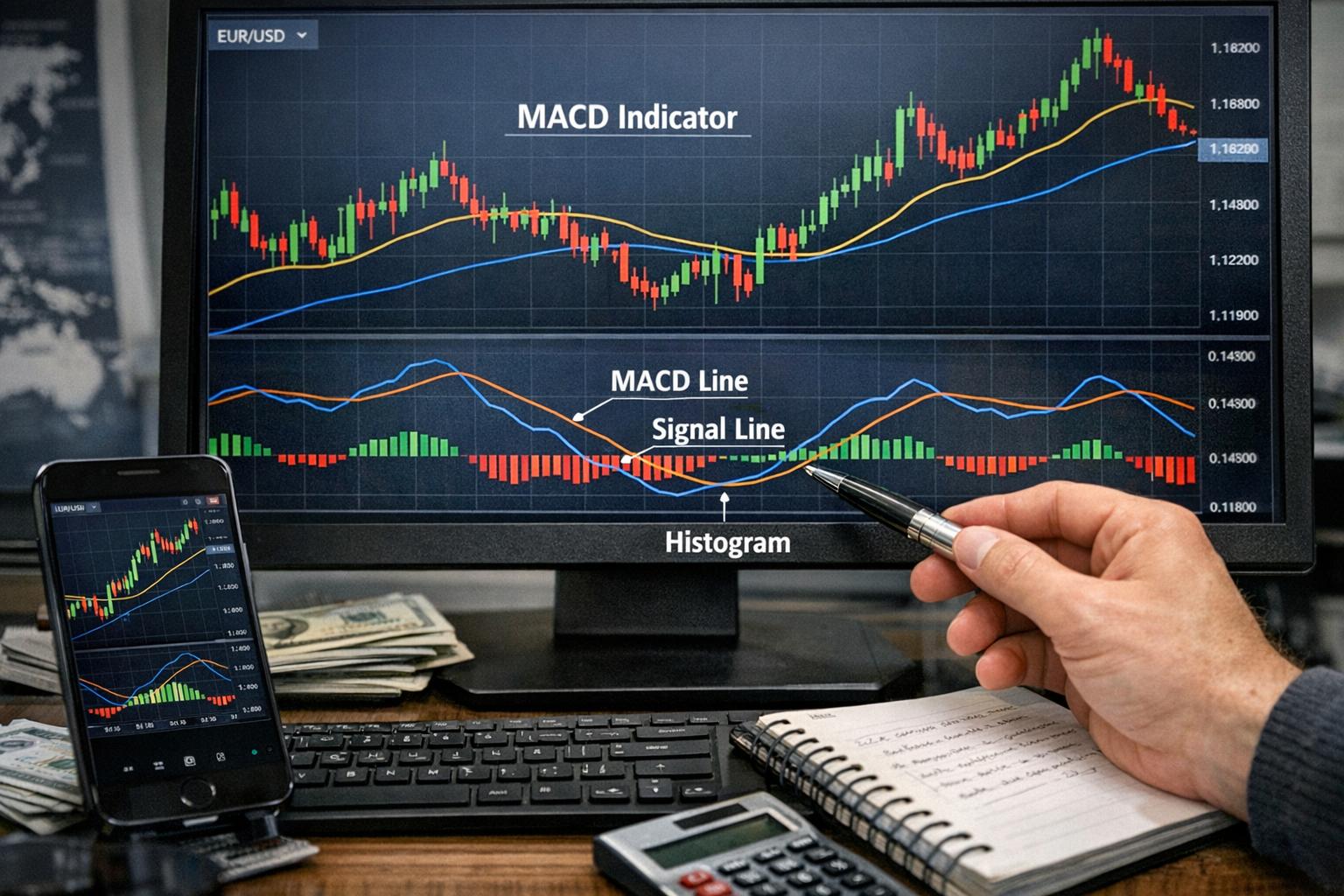

Understanding Divergence in Forex Trading
Forex trading has a way of humbling everyone. You can do everything “right” and still get stopped out because price decided to sprint in a direction your chart didn’t predict. That’s why many traders stay obsessed with repeatable methods—ways to interpret market behavior that don’t rely on vibes or a lucky coin flip.
One such method is divergence. It’s not magic, and it won’t turn every chart into a guaranteed setup. But in clear market conditions, divergence can highlight when momentum is weakening, when trend strength is fading, or when price is pushing while indicators quietly say “not so fast.”
This guide expands on divergence in forex: what it is, the main types, why it works (at least in the way traders care about), and how to apply it without turning your strategy into a pattern-recognition circus.
What is Divergence?
Divergence happens when price action and a technical indicator disagree.
In practical forex terms, you’ll often see divergence when:
– A currency pair (like EUR/USD) makes a new high (or low) on the chart
– But an indicator tied to momentum or price structure—such as the Relative Strength Index (RSI) or the Moving Average Convergence Divergence (MACD)—fails to make a corresponding new extreme
So instead of price and indicator moving in lockstep, they “split.” That split can suggest that the move is losing force. If that weakening aligns with other context (support/resistance, trend direction, market structure), divergence can become a useful signal.
Here’s the core idea traders use: divergence is essentially a warning sign. It doesn’t prove a reversal by itself. It flags a mismatch between what price is doing and what the indicator suggests about underlying momentum.
Why indicators matter for divergence
Price is what happens on the chart. Indicators are interpretations—math-based summaries of price behavior over time.
Different indicators “measure” different things:
– RSI focuses on momentum by comparing recent gains to recent losses.
– MACD focuses on trend/momentum by comparing moving averages and their relationships.
Divergence, then, is a mismatch between what price shows and what the indicator believes is happening underneath.
If you’ve ever watched price tap a resistance level a second time while RSI refuses to go anywhere meaningful, you’ve already met divergence in real life. It’s one of those chart moments that feels obvious after it happens—and confusing while it’s forming.
Types of Divergence
Most traders talk about two main categories:
– Regular divergence
– Hidden divergence
They look similar at first glance (there’s always an indicator and a price swing involved), but they’re used differently. Regular divergence is generally read as a reversal hint. Hidden divergence is generally read as a trend continuation hint.
Regular Divergence
Regular divergence is used to anticipate potential trend reversals.
There are two forms:
1) Bearish regular divergence
Price makes higher highs. But the indicator makes lower highs.
This setup suggests the upside push is weakening, even though price keeps climbing. Traders often interpret it as a potential reversal to the downside.
2) Bullish regular divergence
Price makes lower lows. But the indicator makes higher lows.
This suggests selling pressure is fading. Even if price is still dropping, the indicator implies the momentum behind the drop is weakening. Many traders treat this as a potential reversal to the upside.
A simple rule: with regular divergence, price and indicator extremes move against each other, and the direction of the divergence often hints at a reversal.
Hidden Divergence
Hidden divergence is typically used to spot trend continuation. It’s a “don’t get too excited” pattern—unless the context confirms it.
Two forms exist:
1) Bullish hidden divergence
Price forms a higher low, but the indicator forms a lower low.
In a general uptrend, price makes a pullback low that holds higher than the previous one. The indicator making a lower low suggests that the correction is losing momentum while the larger uptrend keeps its structure intact.
2) Bearish hidden divergence
Price makes a lower high, while the indicator makes a higher high.
In a downtrend, price rallies to a lower high than before. The indicator showing a higher high is read as the rally momentum weakening, consistent with continuation lower.
In other words: hidden divergence often fits the idea that the trend remains intact; the mismatch just exposes that the “pullback leg” is not as strong as it used to be.
Benefits of Divergence Trading
On paper, divergence is just another indicator pattern. In practice, its value comes from what it helps you notice at the right moment: momentum weakening or momentum behaving oddly relative to price.
Identifying potential reversals
Regular divergence is frequently used to mark moments where a trend might be losing its grip.
For example, imagine EUR/USD is trending up. Price pushes to a new high again, but RSI fails to confirm that strength with a higher high. That mismatch can be an early warning that the “buyer power” behind the move is weakening.
That doesn’t mean the reversal is immediate. What it gives you is a reason to watch for reversal behavior—like rejection candles, breakdowns through minor swing levels, or indicator cross/breaks in your momentum tools.
Improving risk management
A lot of traders lose money for the boring reasons: they enter too early, place stops too tight, and assume the chart owes them a win.
Divergence can help you structure entries more carefully because it signals that momentum isn’t supporting the latest price push anymore.
When you’re using divergence responsibly, you can often improve:
– Where you expect the idea to fail (invalidations)
– How you time entries (wait for confirmation)
– Whether a signal is even worth trading (filter by trend context)
In risk management terms: divergence can make your “why” clearer, which makes your plan less emotional.
Complementing other technical analysis
Divergence works best when it’s not the only thing you’re using.
It becomes more credible when paired with:
– Support and resistance (or demand/supply zones)
– Trend lines or moving averages
– Market structure (higher highs/lows in an uptrend, etc.)
– Price action confirmation (breaks of minor swing levels, reversal candles)
– Volume or volatility measures (when available on your platform)
Think of divergence like the warning light. The guage might show something is off, but you still check the engine (context) before you pull into the driveway.
Implementing Divergence in Trading Strategies
This is where many people mess up. They see divergence, they enter, the market shrugs, and they declare the indicator “broken.”
To use divergence well, you need a repeatable process: noticing, validating, timing, and managing.
Use reliable indicators
RSI and MACD are common because traders understand them and because they tend to react clearly around swing points.
However, “reliable” doesn’t mean “always correct.” It means consistent behavior when used with a disciplined method.
Here’s how traders often use them:
– RSI: Great for spotting momentum mismatches at swing points.
– MACD: Often used to confirm the momentum shift and the trend/momentum relationship.
A practical tip: keep your indicator settings consistent. Changing RSI periods from 14 to 9 to “whatever feels right today” will make backtesting meaningless. Divergence analysis is sensitive to indicator behavior, so your parameters should stay stable.
Combine with other tools
If divergence is your “signal,” your other tools are your “confirmation.”
Good companions include:
– Trend filter: trade divergence in the direction of the larger trend (more often with hidden divergence, sometimes with regular depending on your approach).
– Structure filter: identify where price is relative to recent swing highs and lows.
– Support/resistance: if divergence occurs right at a level where price often reacts, that’s more believable than if it happens in the middle of nowhere.
A simple combo many traders use:
1) Identify divergence on RSI or MACD
2) Wait for price action confirmation (break of a minor level, reversal candle, or rejection)
3) Enter with a stop beyond the invalidation point
4) Target the next logical structural level (not “hope and vibes”)
Significance of Practicing Discipline in Divergence Trading
Divergence is not a guaranteed forecast. It’s a probabilistic clue—useful when applied correctly, annoying when applied casually.
The disciplined part matters because divergence creates a temptation: you can “see” patterns where there aren’t any consistent extremes, or you can force an indicator to make a higher high where the chart barely agrees.
If you’ve ever drawn two lines quickly just to feel productive… yep, that’s the trap.
Watch out for false signals
False signals happen for standard reasons:
– The market continues trending, and your divergence was just a hiccup in momentum.
– The timeframe is too noisy, so indicator swings don’t represent real momentum shifts.
– Price makes a marginal new high, but the indicator’s “new high” isn’t actually meaningful.
One way to reduce that risk is to demand a clearer divergence “shape”:
– The divergence should involve meaningful swing points (not tiny blips)
– The indicator’s swing should be distinct (not nearly flat movement)
– There should be a market context reason (trend fatigue, approach to resistance, breakdown risk)
Also, treat divergence as a setup for confirmation—not an automatic entry.
Evaluate the market context
Market context changes everything.
Divergence against the dominant trend can work, but it’s generally lower probability unless the broader structure supports reversal. Divergence aligned with trend direction often fits more smoothly, particularly hidden divergence.
Context includes:
– Higher timeframe trend (are you in an uptrend on the daily while trading a divergence on the 1H?)
– Major news and scheduled events (CPI, NFP, central bank announcements)
– Range vs trend conditions (divergence behaves differently in choppy markets)
– Typical volatility for the pair you’re trading
For example, during major event weeks, momentum can whip around abruptly. In those conditions, divergence signals might appear frequently—but the market can “fake out” you more than usual.
Continuous learning and adaptation
Divergence isn’t one-and-done learning. You improve by testing how your specific settings and rules behave over time.
A practical approach:
– Backtest your divergence rules on historical data
– Note which indicator settings made the signals cleaner or noisier
– Track performance by regime (trending periods vs ranging periods)
– Adjust your confirmation criteria (wait for a deeper break, require RSI level behavior, etc.)
The aim isn’t to “optimize until it works perfectly.” That’s how traders end up with a strategy that only performs on past charts. The aim is to identify patterns that hold up across multiple conditions.
If you trade with a journal, you’ll notice something quickly: your emotional errors show up in the stats. Divergence trading punishes impulsive entries most of all.
How to spot divergence in practice (RSI and MACD)
Let’s make this more concrete, because divergence is subtle and reading it differently changes results.
RSI divergence checklist
When using RSI, focus on the relationship between swing points:
– Find two recent price swings (two highs or two lows).
– Check whether RSI made the same kind of swing extremes (higher high vs lower high, higher low vs lower low).
– Confirm whether the mismatch matches a regular or hidden divergence idea based on trend structure.
In many cases, you’ll see RSI “turn” earlier than price. That earlier turn is the moment traders usually pay attention to.
But don’t rush. The better practice is to wait until price completes its second swing and then evaluate whether the RSI really diverged.
MACD divergence checklist
MACD is slightly different because it has multiple lines and histogram behavior depending on your settings (and chart style).
A lot of traders focus on:
– MACD line vs signal line behavior around turn points
– Histogram rising/falling relative to price swings
– Divergence between price and MACD highs/lows at comparable swing locations
One common issue: MACD can be laggy depending on settings. That lag can still be fine, but it means you should match your confirmation timing to what MACD is telling you.
Entry and exit ideas without turning it into a guessing game
Divergence signals become actionable when you define what “success” looks like and what invalidates the idea.
Defining invalidation
A practical invalidation rule might be:
– For bearish regular divergence: if you enter short, your stop should sit beyond the recent price swing high that formed the divergence
– For bullish regular divergence: your stop sits beyond the recent swing low
This approach keeps the strategy grounded. If price goes through the level with momentum, your divergence thesis is wrong. You exit and move on.
If you place stops inside random wiggles, divergence will have you paying for normal market noise, which can be expensive.
Confirmation methods that actually help
Confirmation varies by trader, but common options include:
– Break of the most recent lower low (in bearish setups) or higher high (in bullish setups)
– Rejection from a key level (support/resistance)
– RSI level behavior that aligns with the reversal idea (like RSI pushing away from a commonly watched threshold when you use it)
The goal is to reduce the “it looked like divergence so I entered” problem. Confirmation turns the idea into a trade.
Divergence strategies people commonly use
There are several ways divergence fits into broader strategies. Below are a few patterns you’ll see in live trading, phrased in a way you can adapt.
Trend reversal watch (regular divergence + structure)
This is the classic approach for regular divergence:
– Identify bearish regular divergence after a price up-move into resistance
– Wait for a break in nearby structure to confirm weakness
– Enter on the confirmation, target the next support level
You’re not trying to catch the exact tick of reversal. You’re trying to capture the reasonable portion of the move after momentum truly changes.
Trend continuation (hidden divergence + pullback context)
Hidden divergence is often treated like a “trend is still alive” hint.
– In an uptrend, look for bullish hidden divergence during a pullback
– Wait for signs that sellers are losing control (price breaks back higher, structure holds)
– Enter in the direction of the broader trend
This can be especially helpful because it avoids chasing new highs. Instead, you trade the pullback quality.
Range trading caution (divergence can mislead)
In tight ranges, divergence signals appear often because price swings in both directions. This doesn’t automatically make divergence useless, but it does mean you need better filtering.
A strict range-trading environment might push you toward:
– Using divergence more cautiously
– Demanding clearer alignment with range edges (support/resistance)
– Being more selective about timeframe and swing size
If every small swing produces a divergence, you’ll end up stacking trades that are basically taking turns poking you with fees and spreads.
Timeframes: how far can you zoom out?
Timeframe choice changes divergence behavior.
On lower timeframes (like 1m or 5m), divergence signals show up frequently due to noise. This can create many trade opportunities, but it also creates many false matches.
On higher timeframes (like 4H or daily), divergence is rarer but often more meaningful. However, entries take longer, which can lead to missed opportunities if your planning isn’t solid.
A practical compromise many traders use:
– Identify the bigger divergence on a higher timeframe
– Execute on a lower timeframe with confirmation
This hybrid approach is often smoother because the higher timeframe provides direction, while the lower timeframe provides timing.
Common mistakes when trading divergence
If you want divergence to behave, you have to treat it like a method—not a superstition.
Forcing divergence where none exists
Sometimes traders mark two indicator swings that barely differ and call it divergence. That’s not analysis; it’s doodling.
If the indicator swing doesn’t clearly conflict with price structure, don’t label it. Wait for real separation and real swing points.
Ignoring timeframe mismatch
A divergence on one timeframe might be meaningless on another. For example, a 15m divergence could appear frequently inside a longer uptrend. If you trade it like a reversal on the 15m chart without considering the larger structure, you can get chopped up.
Entering without confirmation
Divergence is usually strongest as a warning or setup. If you enter immediately just because you drew lines, you’re basically gambling the market will reverse exactly on your terms.
Try building a confirmation rule into your process, even if it’s simple: wait for a break in a relevant swing level.
Using divergence as the entire strategy
Indicators are helpful, but they don’t replace structure. The best divergence trades tend to align with where price is in the market: levels, trend, and next likely movement.
If your divergence signal appears mid-range with no clear structure and no support/resistance nearby, it’s less likely to be actionable.
Risk management considerations specific to divergence
General risk management applies to everything in forex, but divergence invites a couple of specific concerns.
Spreads and stop distance
Divergence trades often rely on stops beyond swing highs/lows. On higher timeframes, those swing distances can be wide. Wide stops mean either smaller position sizing or a reduced trading frequency so you don’t risk too much per trade.
If you keep position size unchanged while stops widen, you’ll see your risk drift outside your plan fast.
Time-based exits
Sometimes divergence signals form, you enter with confirmation, and then price goes nowhere for a while. That “stuck” period costs you spread/rollover depending on your holding time and account type.
A time-based exit rule (like exiting if structure doesn’t break within a certain number of candles) can help prevent slow-motion losses. It’s not required, but it’s worth testing.
Partial scaling
If you trade divergence toward the next structural level, scaling out can reduce stress. For instance, you may take partial profit near a nearby support/resistance and leave the rest to run if confirmation holds.
This isn’t mandatory, but it fits divergence trading well because divergence often predicts momentum change, and momentum change can unfold in stages.
A realistic example (how traders think about it)
Let’s walk through a typical scenario a trader might see.
Say you’re watching GBP/USD on the 4H chart. The price has been trending down, making lower lows. You notice the pair forms another lower low, but RSI does something odd: the RSI low is higher than the previous RSI low. That’s bullish regular divergence.
Now you still don’t automatically buy. You look for context:
– Is price approaching a known demand area or a prior support from earlier structure?
– Does the lower timeframe show rejection candles around the 4H divergence zone?
– Does price break back above a minor swing level that suggests the selling move is losing control?
Once those pieces align, taking the trade becomes logical. If price keeps falling through the divergence low with momentum, your plan is already defined: you’re wrong, you exit. If momentum changes and structure breaks, you get what divergence warned you about: a shift in strength.
That’s the responsible version of divergence trading. Not the “I saw a mismatch so the market must reverse” version.
Does divergence work in every market?
No, and anyone who says yes is selling something.
Divergence tends to work better when:
– Price is making meaningful swing highs/lows (not random candle noise)
– The indicator choice reflects momentum reasonably well
– Market structure supports the idea (trend fatigue at levels, or pullback behavior in trend continuation)
– Liquidity and volatility are not causing constant whipsaws (though some whipsaws are normal)
In strong trends, regular divergence can show up frequently without turning into an immediate reversal. Traders often learn the hard way that “momentum weakening” doesn’t always mean “trend ending.” It can mean consolidation first.
Hidden divergence sometimes fares better for continuation trades in established trends, because it aligns better with the concept of ongoing structure.
If you want a simple mental model: divergence is most useful when paired with “where price is headed next” based on structure.
Conclusion
Divergence trading offers forex traders a structured way to spot moments when momentum and price stop agreeing. Used carefully, it can highlight potential reversals (regular divergence), flag continuation conditions (hidden divergence), and improve how you plan entries, invalidations, and targets. It’s not a standalone system, and it won’t rescue you from sloppy risk management, but it can noticeably improve the quality of your decision-making.
If you want divergence to work for you, build it into a process: clean indicator settings, clear swing identification, confirmation from price action, and context from higher timeframes and key levels. That’s when divergence stops being “a nice idea” and becomes a repeatable part of your trading toolkit.
No drama required. Just rules, patience, and the willingness to accept when the market doesn’t care about your lines.