
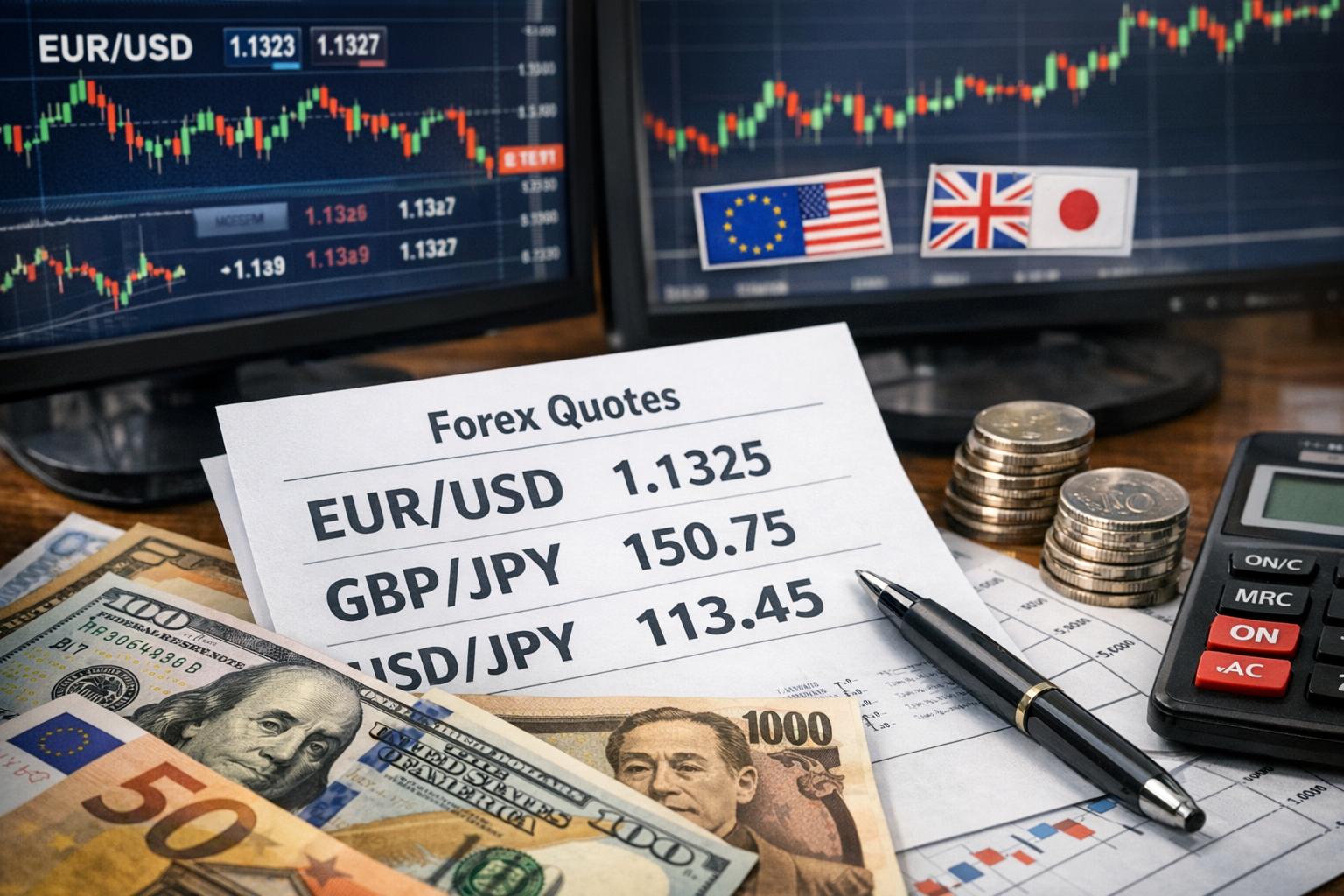
Understanding Currency Pairs in the Forex Market
The forex market is global and a bit unforgiving: when you trade currencies, you’re not buying “money” in the usual sense. You’re making a bet on how one currency will value relative to another. That’s why forex trading is built around currency pairs. If you don’t understand the mechanics of those pairs—what the quote means, how bid/ask works, and why majors behave differently than exotics—everything else (charts, indicators, strategies) will feel like you’re trying to read a map while sprinting.
This guide expands on the core concepts behind currency pairs in forex. It’s written for people who already know the basics and want a clearer mental model before placing real money at risk. We’ll stay focused on the pair structure and the way prices are presented, then connect those ideas to how traders actually use them.
Currency Pairs: Why Forex Quotes Always Come in Pairs
Forex trades currencies in pairs because currency values move relative to each other. If the price of USD rises against EUR, that means one unit of USD buys more EUR than before. The market expresses that relationship directly through a pair.
A currency pair name usually follows this pattern: BASE/QUOTE. The slash matters because it defines what the number on your screen is actually measuring.
Base Currency and Quote Currency
Currency trading occurs with the pairing of two currencies, structured as a currency pair. Each pair comprises a base currency and a quote currency. The base currency is the first one listed, and the quote currency is the second. Take, for instance, the EUR/USD pair: here, the Euro (EUR) functions as the base currency, whereas the US Dollar (USD) acts as the quote currency.
What the Base Currency “Means” to the Trader
The base currency is the one you’re effectively buying or selling when you take a position. In an order ticket, your trade direction is tied to the base currency’s performance relative to the quote currency.
For example, with EUR/USD:
- When you buy EUR/USD, you’re buying the base currency (EUR) and selling the quote currency (USD) at the current market rate.
- When you sell EUR/USD, you’re selling EUR and buying USD.
That’s the whole game: positions are directional, but the market quotes the relationship as a price.
What the Quote Currency “Means” to the Trader
The quote currency is the measurement tool. It tells you what amount of the quote currency corresponds to one unit of the base currency.
So when the quote currency changes, the “value scale” changes too. That matters for volatility, price behavior, and even for how spreads feel across different pairs.
Interpreting Currency Quotes
When presented with a currency pair’s quote, such as EUR/USD = 1.2000, it suggests that one unit of the base currency (1 Euro) is equivalent to 1.2000 units of the quote currency (1.2000 US Dollars). This price demonstrates the amount of the quote currency required to purchase a single unit of the base currency.
It also tells you what happens when the pair moves:
- If EUR/USD goes from 1.2000 to 1.2100, EUR is stronger relative to USD (or USD is weaker relative to EUR).
- If EUR/USD goes from 1.2000 to 1.1900, EUR is weaker relative to USD.
Notice how everything is relative. The market doesn’t claim EUR “became better” in isolation; it simply reflects the change in the exchange rate between the two.
Common Confusion: “Which Currency Is Increasing?”
New traders often ask: “If EUR/USD increases, is EUR up or USD up?” The clean answer: in EUR/USD, when the pair increases, the base currency (EUR) is gaining vs the quote currency (USD). USD is effectively losing purchasing power against EUR.
This matters because many risk decisions depend on direction. A strategy that expects “USD to strengthen” should trade pairs where USD strengthening means the pair price moves in the expected direction.
How Bid and Ask Prices Work (and Why Spreads Are Not Just an Annoyance)
Every forex quote comes with two prices because the market has buyers and sellers. That pair quote isn’t one fixed number—it’s a small battle between demand and supply.
The Bid-Ask Spread
For each currency pair, there are two essential prices: the bid and the ask. The bid price is what the market or a broker is willing to pay to buy a specific currency pair from you. Conversely, the ask price represents what the market or broker expects to receive by selling the currency pair to you. The spread—the difference between the bid and ask prices—is a common gauge of the transaction costs involved in forex trading.
Buy at the Ask, Sell at the Bid
This is the part traders feel in their account even if they don’t talk about it much. When you:
- Buy a pair, your entry price is typically the ask.
- Sell a pair, your entry price is typically the bid.
Then your exit price depends on direction again. In other words, you don’t “start even” on day one unless the spread is zero (and in real life, it’s not).
Why Spreads Expand in Real Events
Spreads tend to widen when markets get jumpy: major economic releases, central bank announcements, sudden geopolitical headlines, or times of low liquidity (certain hours, holidays, etc.).
This doesn’t always mean the strategy is wrong, but it does change the cost structure. A method that targets a 10–15 pip move may suddenly struggle when spread jumps to a chunkier number. That’s not theoretical—it’s the sort of thing that shows up quickly when you trade through high-impact news.
How Spreads Differ by Pair
Major pairs usually have tighter spreads because they’re liquid and heavily traded. Exotic pairs often have wider spreads due to thinner liquidity and more uneven participation. You can think of liquidity like crowd size at an event: larger crowds generally move faster and price differences stay smaller. Smaller crowds mean more gaps and slower price action.
Direct and Indirect Quotes: The “Home Country” Detail
Currency quotes can be presented in different ways depending on where the quote is coming from and how the country traditionally expresses exchange rates.
Direct and Indirect Quotes
Currency quotes can further be categorized into direct or indirect, largely dependent on the trader’s home nation. A direct quote denotes the amount of domestic currency necessary to purchase one unit of a foreign currency. Meanwhile, an indirect quote reflects the quantity of foreign currency that can be acquired with one unit of domestic currency.
Why This Matters Less Than It Used To
In modern retail forex trading, most brokers present pairs in a standardized way around the familiar formats (EUR/USD, USD/JPY, etc.). That means you usually don’t have to manually convert from direct to indirect quotes just to trade.
Still, the concepts are useful. If you ever read an economics report from a country that writes quotes differently, the “number” might feel switched in your head. Understanding direct vs indirect quoting reduces that mental friction.
Types of Currency Pairs
Within forex, currency pairs are divided mainly into three categories. The category matters because each one tends to behave differently: spreads, volatility, and how sensitive the pair is to specific regional news.
Major Pairs
Major Pairs: These are the most traded currencies worldwide and frequently involve the US Dollar as either the base or quote currency, including combinations such as EUR/USD, USD/JPY, and GBP/USD.
Major pairs usually offer:
- Lower spreads due to high liquidity
- More dependable execution during usual market hours
- More consistent reaction patterns to widely covered economic events
This is why they tend to be the starting point for many traders. It’s not because they’re “better,” but because trading costs and execution slippage are usually easier to manage.
Minor Pairs
Minor Pairs: Pairs in this category exclude the USD. They are typically formed from major currencies like EUR/GBP or AUD/CAD.
Minor pairs can have their own flavor. Since they don’t include USD, they may respond more strongly to factors specific to the two involved economies rather than the global USD story alone. For example, a European political announcement and a UK labor report can both matter—just not in the same way they would with EUR/USD.
Exotic Pairs
Exotic Pairs: This grouping involves a major currency paired with a currency from a smaller or emerging market economy, such as USD/SGD or EUR/TRY.
Exotics often bring:
- Wider spreads (more cost each trade)
- Higher volatility (bigger price swings)
- Greater sensitivity to local political and economic developments
That last point is worth pausing on. A stable major-major pair might reflect broader global risk sentiment. An exotic pair can also reflect local central bank credibility, inflation expectations, capital controls, and political risk. You’re trading not only “currency,” but a whole set of country-specific conditions. Fun? Sometimes. Cheap? Usually not.
How Currency Pair Categories Show Up in Price Action
Here’s a practical way to think about it: pair categories influence liquidity, and liquidity influences how price moves.
When liquidity is high (majors), the market produces smoother transitions. When liquidity is lower (exotics), the price can jump more aggressively between levels, and sudden moves are more common around events.
This doesn’t automatically make exotics “bad.” It just means your strategy needs to respect the market you traded into. If your method assumes spreads stay tight and moves behave smoothly, exotics will punish that assumption.
Applying Currency Pair Concepts in Real Trading
To apply the foundational aspects of currency pairs effectively, traders must delve deeper into market dynamics and gain a practical understanding through practice and experimentation in a live environment. This involves utilizing demo accounts offered by various brokers before committing real funds, which can help in familiarizing oneself with the functionality of forex platforms, understanding transaction costs, and honing technical analysis skills.
What to Practice Specifically (So It Actually Helps)
Most beginners learn the idea of base and quote currency, then move on. But the profitable part is getting comfortable with execution details. You can practice these without risking capital:
- Switch between buying and selling and confirm how it maps to charts (does the pair move “the way you expect”?)
- Compare spread behavior across major vs exotic pairs during normal hours
- Watch how the pip value and price scale feel different depending on the pair
Don’t rush. Demo accounts can hide some real-world slippage, but they still show you how quotes and spreads work in your broker’s environment.
A Small Real-World Example
Suppose you’re watching EUR/USD and you see it drop. You assume USD got stronger. Now you check USD/JPY and notice it’s rising too. That can happen because USD strength can pull multiple USD pairs in the same direction.
But if EUR/GBP is also falling while EUR/USD is falling, the message isn’t just “USD is strong.” It could be “EUR is weakening vs multiple counterparts.” Currency analysis often becomes clearer once you compare several pairs and understand their shared base or quote currency.
Key Considerations for New Forex Traders
For newcomers to the Forex market, understanding the differences between currency pairs is vital. Major pairs typically offer lower spreads, implying reduced transaction costs, which can be beneficial in volatile market conditions. Meanwhile, exotic pairs might entail higher spreads and be significantly influenced by geopolitical events from emerging markets, demanding more caution.
Additionally, assessing volatility is crucial; it requires understanding how much a currency pair’s price might move over a given period. Higher volatility can provide more opportunities for profits but also increases risk. Consequently, risk management strategies, such as setting stop losses, are paramount to safeguarding capital and maintaining sustainable trading practices.
Volatility: The “Speed of Change” You Need to Respect
Volatility doesn’t mean “risk” by itself, but it strongly affects risk. Higher volatility means your stop loss might be hit more often. It also means your target levels may need adjustment, otherwise the market won’t reach them often enough to make the strategy viable.
Example: If you trade a pair that regularly swings 80–100 pips in a day, but your setup expects 20–30 pip moves, you may find your entries are late or your stops are too tight for normal price behavior.
Liquidity: Why Execution Quality Shows Up in the Small Stuff
Even if your analysis is right, poor execution can wreck results. Major pairs usually have better depth, which tends to reduce sudden gaps caused by limited orders. Exotics can be trickier: spreads widen and prices can jump between levels.
If you’ve ever entered a trade, watched price move in your favor, then saw it snap back to your stop because it overshot—this is often what traders mean when they talk about liquidity and market microstructure. It’s not magic, it’s just how orders match.
Technical Analysis for Currency Pairs
In the exploration of currency pair dynamics, applying both technical and fundamental analysis can bolster trading decisions. Technical analysis involves studying price movements and chart patterns to predict future trends. It leverages various tools and indicators, such as moving averages and the Relative Strength Index (RSI), to identify potential entry and exit points.
Technical Levels Behave Differently Across Pairs
A support level on EUR/USD might hold more often than a similar-looking level on a high-volatility exotic. That doesn’t mean the concept is wrong—it means the probability distribution of price movement is different.
So when you run a technical setup, ask yourself: “Does this pair usually respect levels, or does it freewheel through them?” Your expectations should match the instrument.
RSI and Overbought/Oversold: Use It, Don’t Worship It
RSI can be helpful for spotting momentum extremes. But currency pairs—especially volatile ones—can stay “overbought” or “oversold” longer than you expect if a macro trend is strong.
Think of RSI as an alert light, not a stop sign. It tells you something about momentum conditions; it doesn’t guarantee a reversal will happen the next candle.
Fundamental Analysis for Currency Pairs
Conversely, fundamental analysis considers broader economic indicators and news events that might impact currency values. This includes interest rates, economic reports, and geopolitical developments. Successful forex trading often involves combining both analyses to provide a comprehensive view of the market.
Interest Rates: The Big Driver Behind Many Pair Moves
Interest rate differentials are a major force in forex. When one country’s interest rates rise relative to another, that can attract capital and support that currency.
This is why traders often watch central bank expectations closely. Rate rumors can create moves even before official decisions arrive.
Economic Releases: Scheduled Volatility
Jobs reports, inflation data, GDP readings, and manufacturing indexes can move currency pairs sharply. The effect depends on what the market expected and how the data compares to forecasts.
Two releases with the same headline can have different impact if expectations differ. In short: the surprise factor matters.
Geopolitics: The Unscheduled Event
Geopolitical developments can influence “risk sentiment.” When risk appetite falls, investors may move toward certain currencies perceived as safer, and away from others. Exotics can react more violently because the risk premium demanded by markets can change fast.
This is especially important when trading pairs that include currencies attached to emerging-market risk factors.
How to Combine Technical and Fundamental Views Without Getting Lost
Combining technical and fundamental analysis is usually about time horizons. Fundamentals often drive broader direction over days or weeks, while technicals help with timing entries and exits.
A practical workflow many traders use:
- Check the calendar for major economic events relevant to the currencies in your pair.
- Align your bias with the likely fundamental direction (or at least accept the risk of being wrong).
- Use technical structure to choose levels for entry, stop, and target.
This reduces the classic beginner mistake: trading a perfect chart pattern right into a scheduled rate decision with a stop that’s too tight. Sometimes the chart is fine—the calendar just disagrees.
Enhancing Knowledge Continuously
The forex market is ever-evolving, influenced by numerous factors ranging from economic shifts to technological advancements. As such, traders should commit to continuous learning and adaptation. Utilizing informational resources, attending seminars, and engaging with forex communities can provide valuable insights and keep traders updated with the latest market trends and strategies.
Keep a Pair “Journal” for Better Pattern Recognition
One of the best habits isn’t flashy: track what you trade and how it behaves. For each currency pair you use, note:
- Typical spread conditions
- How it reacts to major news events
- Whether your stop distances match normal movement
After a few months, your notes start to sound like a personality profile. Some pairs are calm, some are jumpy, some pretend to be logical until they aren’t. That’s just trading life.
Conclusion
Mastery in understanding how currency pairs are quoted in forex is a foundational requirement for effective trading. It necessitates a deep comprehension of base and quote currencies, nuanced interpretation of bid-ask spreads, and the ability to distinguish between different types of currency pairs and quote formats. For those seeking further insight into these fundamental elements, resources such as Investopedia can be beneficial. This foundational knowledge empowers traders to form informed decisions within the complex, dynamic forex market, guiding actions with prudence and confidence while navigating this vast financial realm.